AI-Powered Algorithm Design,
At Your Fingertips.
Define your assets, articulate your strategy, and set your risk parameters in plain English. OCULUS interprets your intent, architecting sophisticated, institutional-grade trading strategies in seconds. No syntax hurdles, just pure alpha.
- ✦ Natural Language Processing
- ✦ Dynamic Risk Mitigation
- ✦ Instant Strategy Synthesis
Institutional Grade. Iterative Memory.
OCULUS doesn't just build; it remembers. Every version, every backtest, and every adjustment is stored in an ongoing memory bank, allowing you to refine strategies until they reach perfection.
Infinite Memory
OCULUS archives every iteration of your strategy. Roll back, compare, or merge logic from previous versions at any time.
Rapid Optimization
Each iteration cycle takes roughly 60 minutes to process thousands of data points, ensuring your alpha is mathematically sound.
Sector-Wide Logic
Don't just trade a ticker. Deploy algorithms across entire market sectors or custom-weighted baskets with a single prompt.
Targeted Risk
Define your maximum drawdown and minimum return targets. If the goal isn't hit, OCULUS restarts re-optimization automatically.
1,000s of Data Points Referenced
From macro-economic indicators to micro-structure order flow, OCULUS builds strategies that are battle-tested against the full history of the market.
From Concept to Profit.
Oculus bridges the gap between your intuition and institutional-grade execution. See how your strategy comes to life in four simple steps.
Command the Engine.
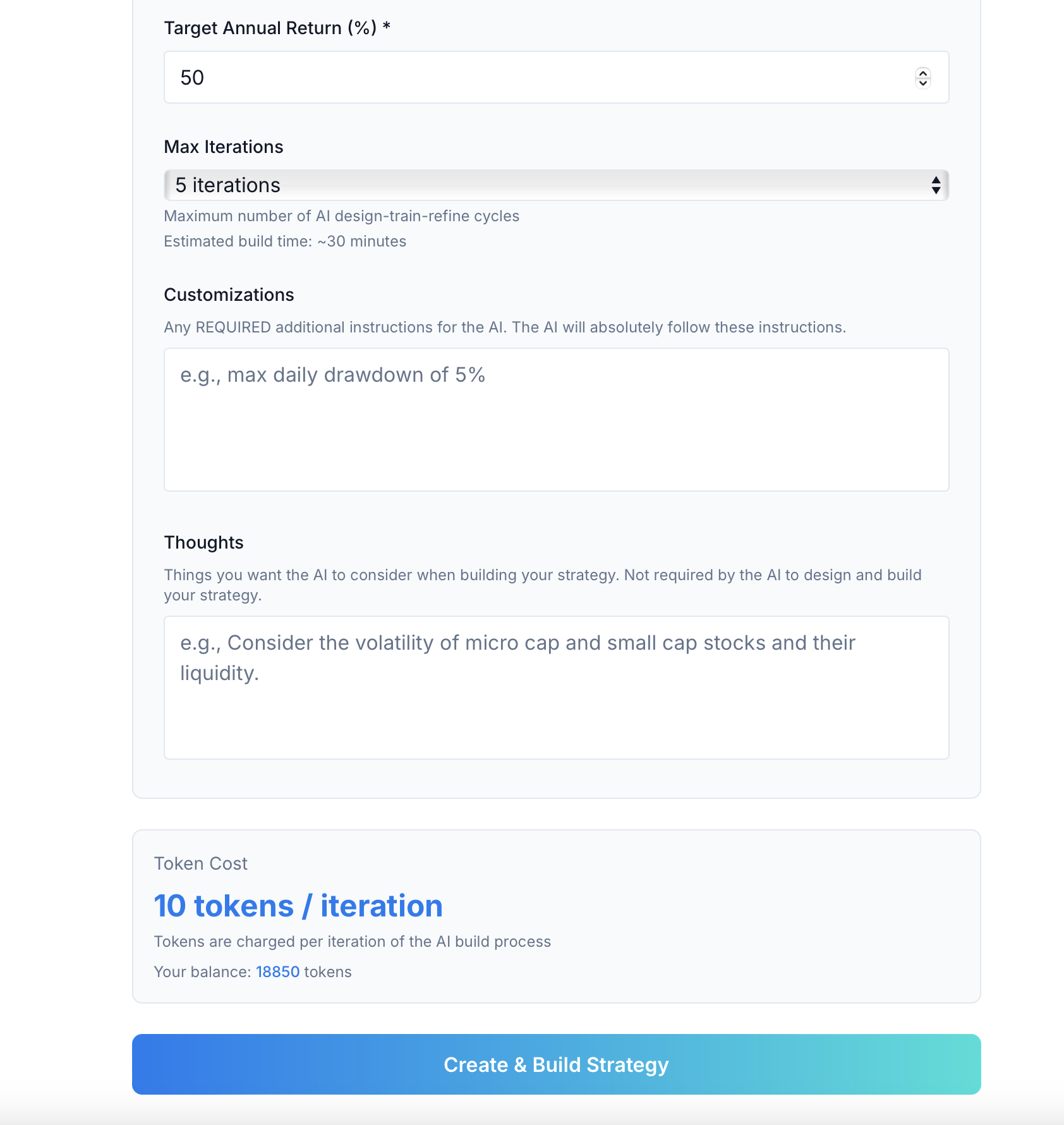
Simply describe your strategy in plain English. Select your assets, define the strategy type, and set your risk parameters (target returns, drawdowns, leverage). The AI converts your intent into a structured trading plan instantly.
Watch the AI Work.
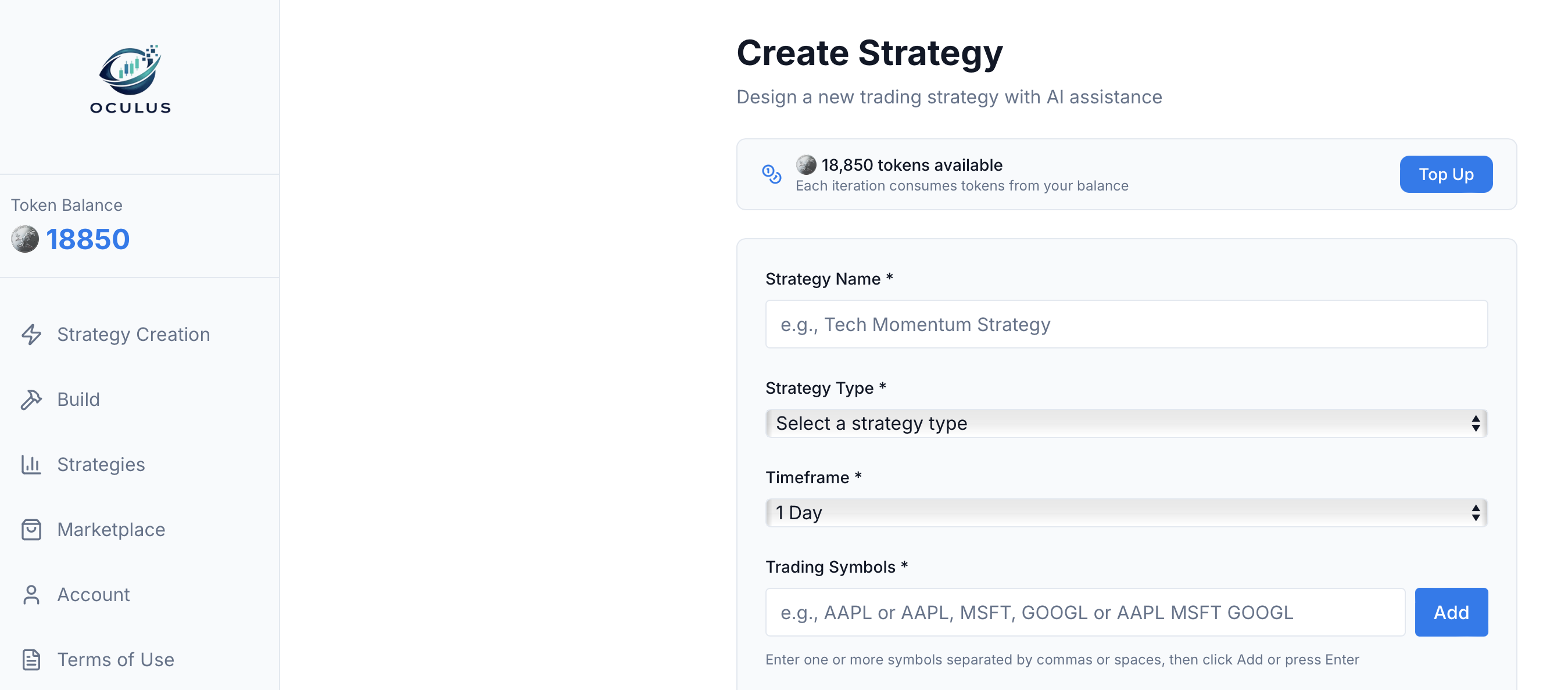
Transparency is key. Watch as the AI architects your strategy in real-time—thinking, designing, testing, and iterating logic chains. No black boxes; just pure, visible logic construction.
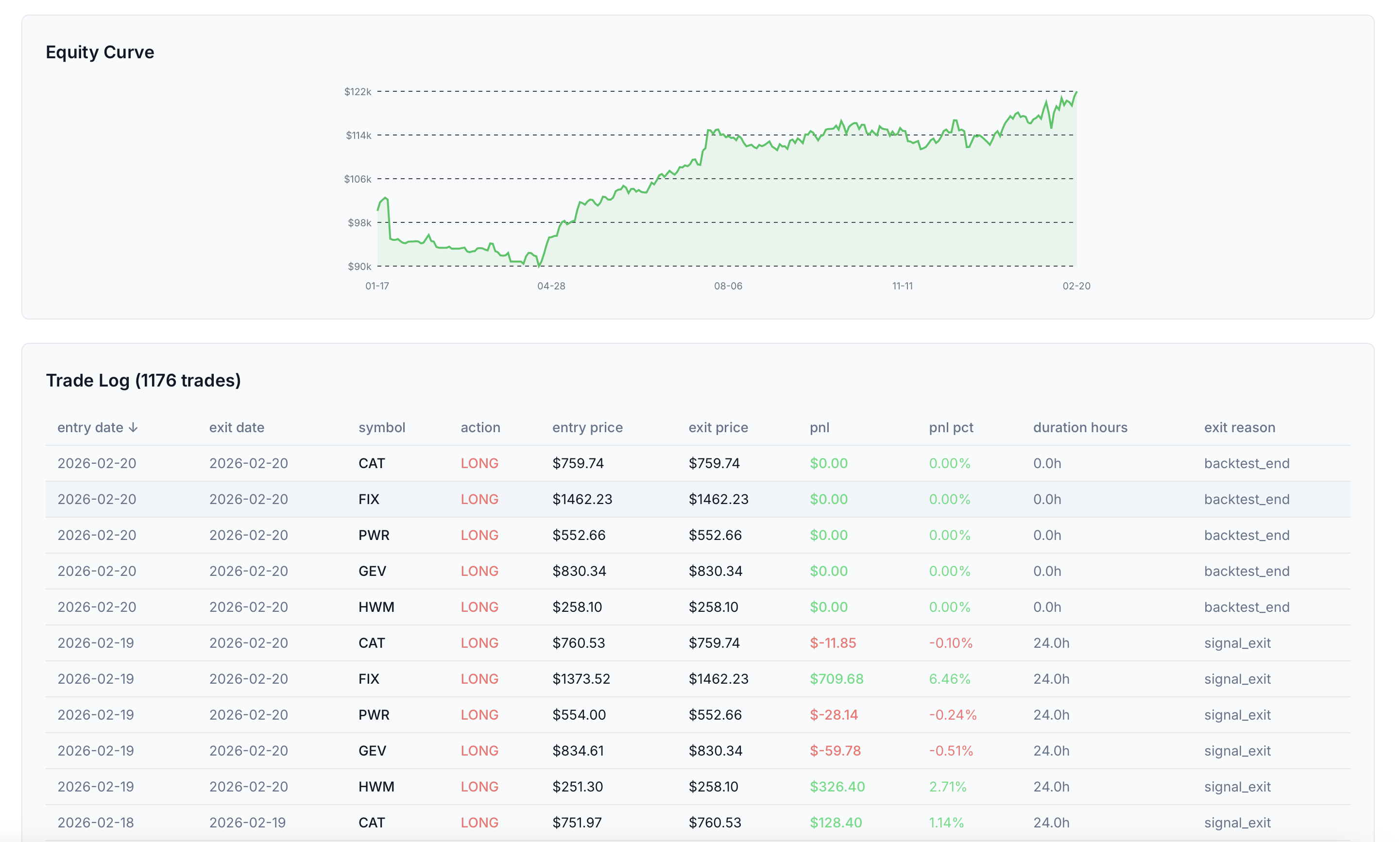
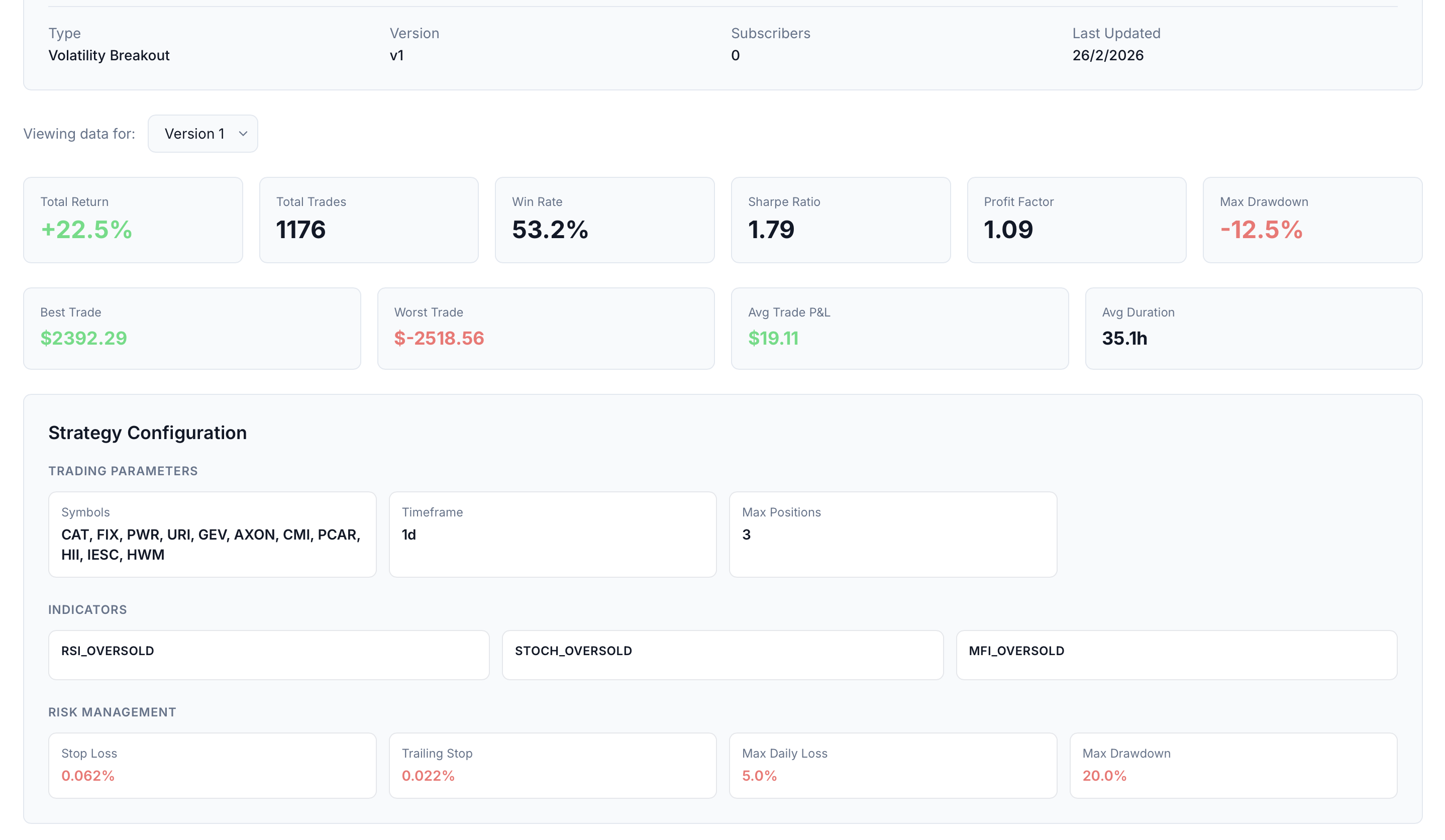
Verify Your Edge.
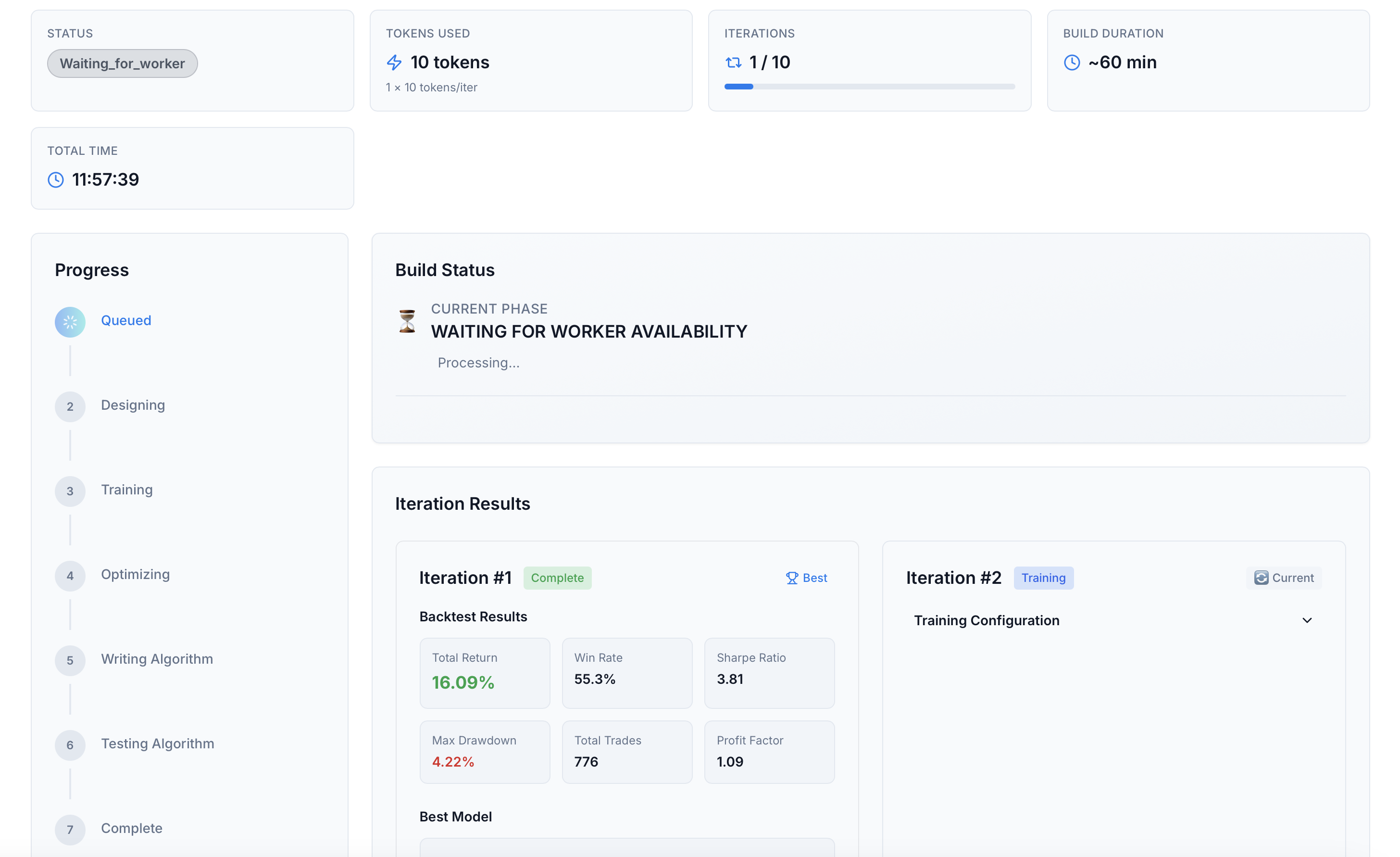
Deep-dive into the results. Analyze comprehensive performance charts, review individual trade logs, and check indicator levels to ensure the strategy meets your exact standards before money is at risk.
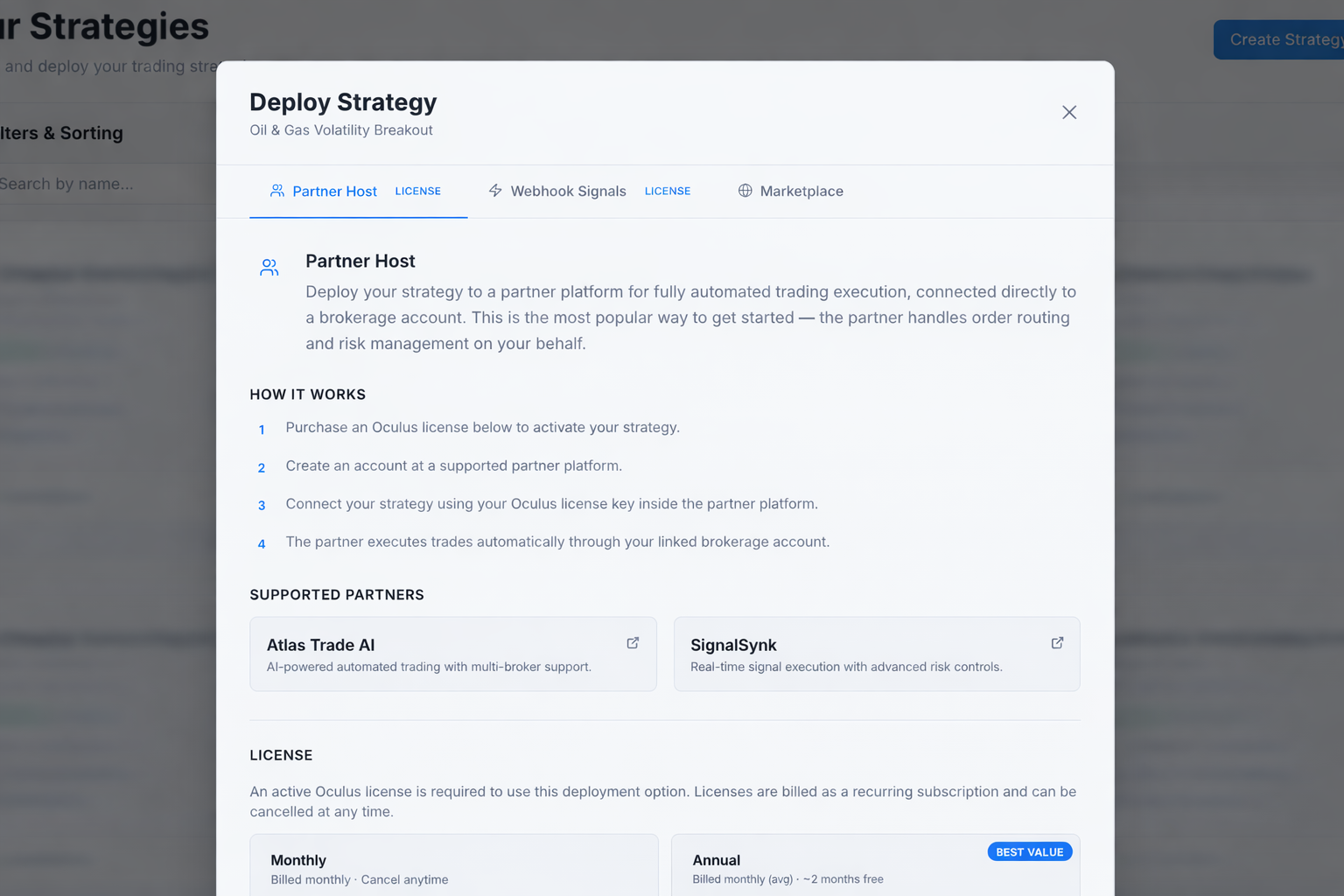
Sovereign Deployment.
Once satisfied, choose your execution path. Connect directly to a Partner Host, broadcast via Webhook Signals to your own tools, or list it on the Marketplace to earn revenue.
Ready to Launch? Choose Your Path.
Once your strategy is built, select the deployment method that fits your infrastructure needs.
Partner Host
Deploy your strategy to a partner platform for fully automated trading execution.
Purchase license to activate strategy.
Connect Oculus key in partner platform.
Partner handles routing & risk automatically.
Webhook Signals
Run on Oculus infrastructure and receive live trading signals as JSON at any endpoint.
Container deploys to our cloud automatically.
Enter your webhook URL endpoint.
Receive JSON payloads to trigger trades.
Marketplace
Publish to the Oculus Marketplace and earn revenue when traders subscribe.
Pricing auto-set by backtest performance.
Submit strategy to public listing.
Keep 65% of every subscription payment.
Frequently Asked Questions.
Everything you need to know about the Oculus ecosystem and algorithmic architecture.
All financial transactions, including monthly subscriptions and on-demand token top-ups, are securely processed via Stripe. We support all major credit cards, Apple Pay, and Google Pay for seamless infrastructure scaling.
Once your strategy is published and generating revenue from other users, you can receive payouts by linking your preferred payment method in the Creator Dashboard. Payouts are distributed on a monthly cycle after reaching a minimum threshold.
Tokens represent the computational power required for OCULUS to iterate on your strategy. Each time you ask the AI to "Piviot" or "Re-optimize" a strategy, tokens are consumed to power the thousands of backtest simulations and data-point references required.
Correct. OCULUS is built on a natural language interface. If you can articulate your market thesis in English, the engine can architect the quantitative code, manage the Docker containers, and handle the API execution for you.
Sovereignty is a core pillar of Oculus. Your strategies are stored in encrypted environments. Unless you explicitly choose to publish your strategy to the Marketplace, your logic remains your private intellectual property.
When you deploy a strategy for personal use, OCULUS wraps the algorithm in a sandboxed Docker container. This ensures your code is isolated, secure, and can execute 24/7 without being affected by external infrastructure changes.
OCULUS references thousands of data points including historical price action, macro-economic indicators, sector correlations, and micro-structure order flow to ensure every iteration is battle-tested against multiple market regimes.
Yes. You can prompt OCULUS to trade specific baskets or sectors (e.g., "The top 10 S&P Tech stocks"). The AI will manage the weightings and correlations across the entire sector automatically.
If a re-optimization cycle fails to meet your defined drawdown or return parameters, OCULUS logs the failure, analyzes why the target was missed, and prepares a new "Chain of Thought" for a subsequent iteration.
On average, a deep strategy iteration takes roughly 60 minutes. This time allows the engine to run exhaustive simulations across years of historical data to ensure mathematical validity.