
Simple, Transparent
Pricing.
Oculus utilizes a straightforward subscription model. Select your plan, receive your monthly allocation of compute tokens, and build. Tokens reset automatically each month, and you maintain absolute control to top-up or scale whenever you need.
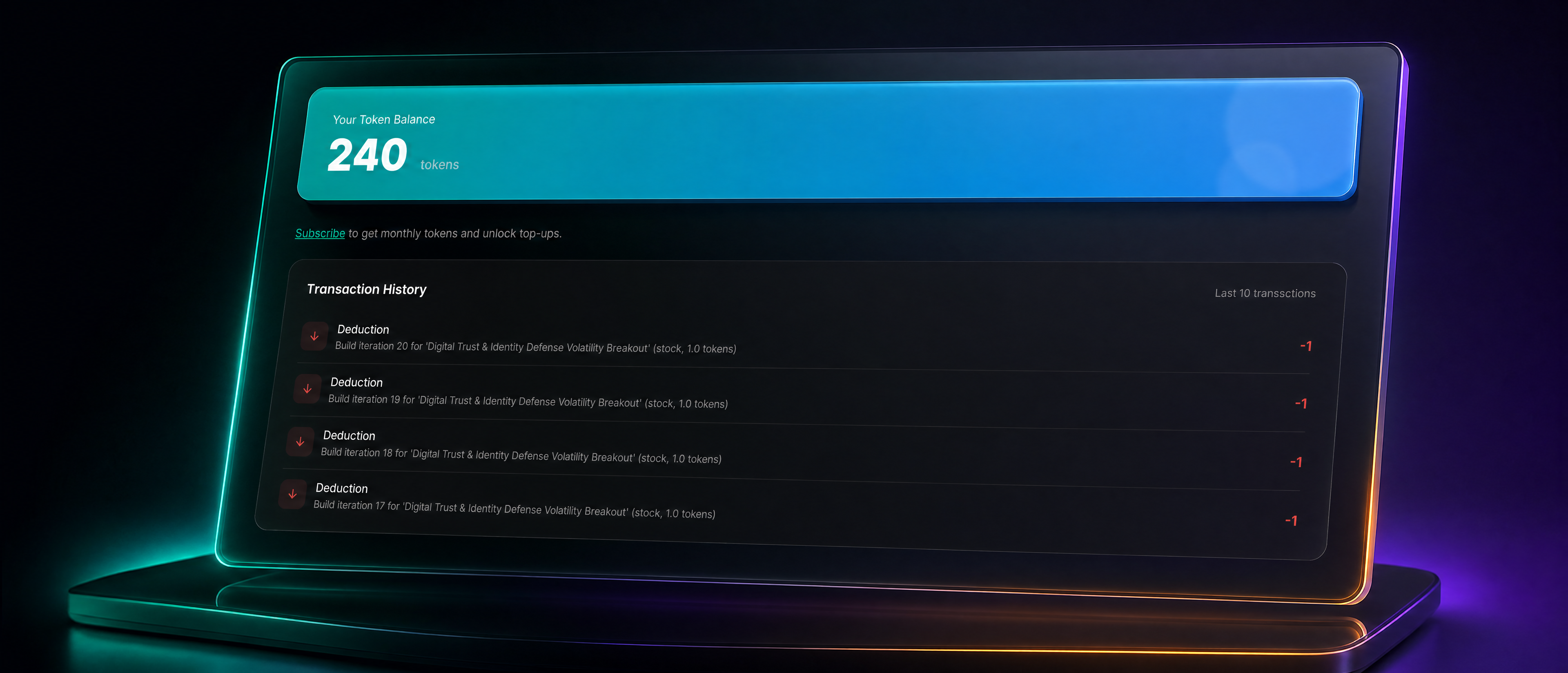
How Tokens Work
Each time you execute a build or optimization cycle, the AI consumes tokens based on computational weight. You can strictly cap "maximum iterations" before every single build.

Basic Tier
- 30 tokens / month
- Top-ups $4/token
- Design, backtest & deploy
Pro Tier
- 120 tokens / month
- Top-ups $2/token
- Design, backtest & deploy
- Cancel anytime
Growth Tier
- 60 tokens / month
- Top-ups $3/token
- Design, backtest & deploy
- Cancel anytime
Secure Infrastructure. Payments processed by Stripe.

Included with every plan.
Each Oculus package comes seamlessly equipped with 1 free Signal Synk connection slot, allowing you to instantly deploy your strategy to a U.S. brokerage upon completion.

Frequently Asked
Questions
Everything you need to know about the Oculus ecosystem and algorithmic architecture.
How are payments and token top-ups processed?
All financial transactions, including monthly subscriptions and on-demand token top-ups, are securely processed via Stripe. We support all major credit cards, Apple Pay, and Google Pay for seamless infrastructure scaling.
What are tokens and how are they used?
Tokens represent the computational power required for OCULUS to iterate on your strategy. Each time you ask the AI to "Pivot" or "Re-optimize" a strategy, tokens are consumed to power the thousands of backtest simulations and data-point references required.
Do I really need zero coding skills to use Oculus?
Correct. OCULUS is built on a natural language interface. If you can articulate your market thesis in English, the engine can architect the quantitative code, manage the Docker containers, and handle the API execution for you.
Is my strategy logic kept private?
Sovereignty is a core pillar of Oculus. Your strategies are stored in strictly encrypted environments. Your trading logic remains your private, highly secure intellectual property at all times.
How does the "Secure Docker System" work?
When you deploy a strategy for personal use, OCULUS wraps the algorithm in a sandboxed Docker container. This ensures your code is isolated, secure, and can execute 24/7 without being affected by external infrastructure changes.
What kind of data does Oculus reference?
OCULUS references thousands of data points including historical price action, macro-economic indicators, sector correlations, and micro-structure order flow to ensure every iteration is battle-tested against multiple market regimes.
Can I build strategies for entire sectors?
Yes. You can prompt OCULUS to trade specific baskets or sectors (e.g., "The top 10 S&P Tech stocks"). The AI will manage the weightings and correlations across the entire sector automatically.
What happens if my strategy doesn't hit its targets?
If a re-optimization cycle fails to meet your defined drawdown or return parameters, OCULUS logs the failure, analyzes why the target was missed, and prepares a new "Chain of Thought" for a subsequent iteration.
How long does a typical iteration take?
On average, a deep strategy iteration takes roughly 60 minutes. This time allows the engine to run exhaustive simulations across years of historical data to ensure mathematical validity.